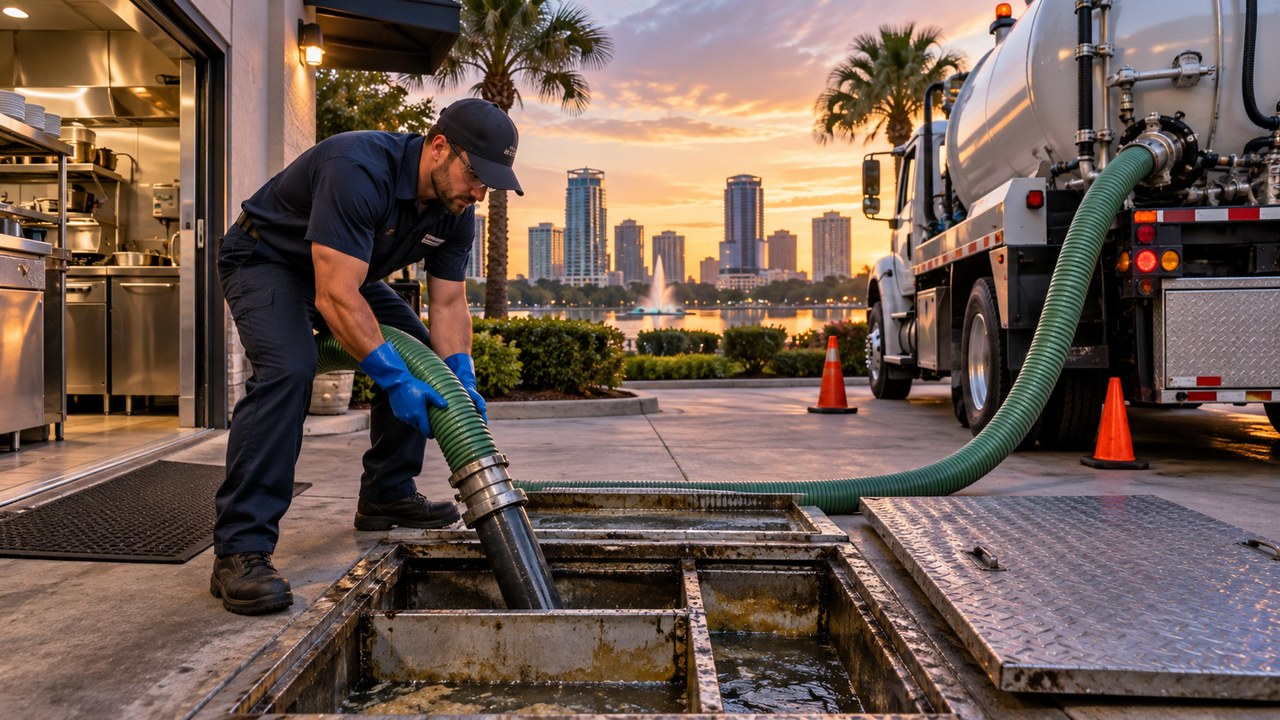
A busy restaurant kitchen rarely gives much thought to the grease trap when everything is working properly. The fryers are running, plates are leaving the pass, servers are moving quickly between tables, and the drains seem to be doing exactly what they should.
Then, suddenly, they are not.
A slow drain turns into an unpleasant odor. Water begins backing up where it should be flowing away. Staff members start asking questions. Guests notice something is wrong. At that point, grease trap maintenance is no longer a routine operating task. It becomes an emergency.
That is exactly why professional Grease Trap Service In Orlando should be treated as preventive maintenance rather than something a restaurant schedules only after trouble begins.
Orlando presents a particularly demanding environment for commercial kitchens. Restaurants around International Drive, downtown dining rooms, resort kitchens, hotel restaurants, entertainment venues and high-volume tourist destinations can serve enormous numbers of meals in a relatively short period. More meals mean more fats, oils and grease entering the wastewater system.
The real challenge is not simply removing grease. It is creating a maintenance schedule that keeps the kitchen operating, reduces the risk of backups and odors, supports compliance requirements and fits around the hours when the business actually makes money.
What a Grease Trap Is Actually Doing Behind the Scenes
Every plate of fried food, every pan rinsed after cooking and every utensil cleaned in a commercial kitchen can contribute some amount of fats, oils and grease, commonly abbreviated as FOG, to wastewater.
A grease trap or grease interceptor is designed to stop much of that material before it enters the sanitary sewer system.
Warm wastewater flows into the trap. As the water begins to cool, grease tends to separate and rise while heavier solids settle toward the bottom. The comparatively cleaner water can then continue toward the wastewater system.
Simple enough.
The problem is that nothing inside the trap disappears by itself.
Grease accumulates at the top. Food particles and other solids accumulate at the bottom. As those layers become thicker, the usable capacity inside the trap becomes smaller.
Eventually, the restaurant reaches a point where the trap cannot perform properly.
This is why Grease Trap Service In Orlando is not simply about pumping out a container. Proper servicing involves removing accumulated material, cleaning the system, checking its condition and documenting the work that has been completed.
Why Waiting Until the Trap Is Full Is a Bad Strategy
There is a common temptation in restaurant operations: if something still works, postpone the expense.
That thinking can become expensive with grease traps.
Imagine a busy Orlando restaurant entering a Friday evening dinner rush. Reservations are full, delivery orders are arriving and the kitchen is working close to maximum capacity.
Then the floor drain starts backing up.
Someone says, “It was draining a little slowly yesterday, but we thought it would be fine.”
Those few words explain a surprisingly common maintenance problem.
Grease accumulation tends to give warning signs before a serious failure. Slow drainage, recurring odors, gurgling pipes or increasingly frequent plumbing issues may indicate that the system needs attention.
Ignoring them does not make the grease disappear.
Professional Orlando Grease Trap Cleaners can remove accumulated grease and solids before they interfere with kitchen operations. More importantly, scheduled service makes maintenance predictable.
Predictability matters enormously in food service.
A planned service visit outside busy operating hours is an inconvenience measured in minutes. An unexpected backup during dinner service can affect employees, customers, sanitation and revenue simultaneously.
Grease Trap Service In Orlando Is Different From Emergency Pumping
These two services may involve some of the same equipment, but the circumstances are completely different.
Scheduled Grease Trap Service In Orlando is preventive. The restaurant knows when the technician is coming. Access can be arranged. Employees can be informed. Service can often be performed when kitchen activity is low.
Emergency service begins with a problem that already exists.
Perhaps the trap is overflowing.
Perhaps wastewater is backing up.
Perhaps a strong odor has developed immediately before a large event.
Perhaps restaurant management has discovered that maintenance records are incomplete shortly before an inspection.
Emergency service has its place, and access to 24/7 assistance can be extremely important for high-volume food operations. But emergency pumping should not become the restaurant's normal maintenance strategy.
The best grease trap emergency is still the one that never happens.
How Often Should an Orlando Restaurant Clean Its Grease Trap?
There is no single schedule that makes sense for every restaurant.
A small café serving sandwiches and coffee does not generate grease at the same rate as a steakhouse, fried-food restaurant, hotel buffet or theme-park kitchen.
Southwaste notes that grease accumulation should not exceed approximately 25% of the trap's volume and indicates that many Orlando kitchens may require servicing roughly every 30 to 60 days. The appropriate frequency, however, depends on the actual operation.
That distinction is important.
Kitchen volume changes everything
Consider two businesses with grease traps of similar size.
Restaurant A serves approximately 150 relatively light meals each day.
Restaurant B serves hundreds of customers daily and operates fryers, grills and a high-volume dishwashing station for long hours.
Giving both restaurants the same pumping schedule simply because their traps are similar in size would ignore the most important variable: what is actually entering the system.
A good Orlando Restaurant Grease Trap Cleaning schedule considers factors such as:
• Trap or interceptor capacity
• Number of meals prepared daily
• Type of food being cooked
• Amount of frying and grilling
• Operating hours
• Seasonal increases in customer volume
• Historical grease accumulation
• Local maintenance requirements
• Previous plumbing or drainage problems
This is where experience becomes valuable. Maintenance frequency should respond to actual grease production rather than an arbitrary date on a calendar.
Orlando's Hospitality Industry Creates Unusual Demands
Orlando is not an average restaurant market.
Tourism changes the rhythm of food service dramatically.
Hotels may operate kitchens for breakfast, lunch, dinner, banquets, room service and private events. Restaurants close to major attractions can experience enormous swings in volume depending on holidays, conventions and tourist seasons. Entertainment venues may produce intense amounts of kitchen waste during relatively short service windows.
Even vacation communities can include clubhouses, poolside kitchens and communal dining facilities that require recurring grease trap maintenance.
For that reason, Grease Trap Service In Orlando often has to fit around the business rather than forcing the business to fit around the service company.
A technician arriving during peak dinner service may create access problems even when the actual pumping process is performed correctly.
Loading areas may be occupied.
Delivery trucks may be arriving.
Kitchen employees may be using access corridors.
Guests may be nearby.
That is why after-hours and overnight service can be particularly useful for hospitality businesses. Southwaste specifically describes scheduling around hotels, resorts, attraction operations and other Orlando food-service environments, including service during quieter hours to minimize guest disruption.
What Professional Grease Trap Cleaning Should Include
Some restaurant owners think grease trap service means a truck arrives, removes liquid and leaves.
A thorough job should involve more than that.
1. Evaluating the trap and service requirements
Before establishing a maintenance program, technicians need to understand the system.
How large is the trap?
How much grease does the business generate?
How quickly has the trap historically filled?
Are there unusual access conditions?
Does the restaurant experience seasonal peaks?
The answers help determine an appropriate servicing frequency.
2. Pumping accumulated material
A vacuum truck removes grease, wastewater and accumulated solids from the interceptor.
Removing only part of the material may leave significant buildup behind, which defeats much of the purpose of the service.
3. Cleaning the trap
Grease can cling to interior surfaces rather than remaining conveniently suspended where it can be pumped away.
Cleaning and scraping accumulated residue helps restore usable capacity and allows the internal condition of the trap to be assessed more accurately.
4. Inspecting the system
An emptied trap offers an opportunity to look for wear or damage.
A maintenance visit can therefore reveal problems before they become more serious.
This is one reason scheduled service has value beyond waste removal. It creates recurring opportunities to observe the condition of equipment that restaurant employees normally never see.
5. Documenting the visit
Records matter.
Professional service documentation can provide evidence of when maintenance occurred, what work was completed and what condition was observed.
For restaurant managers, documentation also creates something very practical: a maintenance history.
Instead of guessing whether a trap should be cleaned every 30, 45 or 60 days, management can compare previous service records and adjust the schedule according to real accumulation.
The Compliance Side Cannot Be Ignored
Grease trap maintenance has a broader purpose than keeping an individual kitchen drain open.
FOG entering wastewater infrastructure can accumulate inside sewer lines, contribute to blockages and create expensive problems downstream.
That is why commercial food establishments are expected to control grease before it reaches municipal wastewater systems.
Southwaste states that its Orlando service is structured around Florida DEP requirements, Orange County requirements and documentation that may be relevant during DBPR and local inspections. It also highlights the 25% accumulation threshold when discussing service frequency.
For the restaurant operator, the practical lesson is straightforward:
Do not treat documentation as an afterthought.
When choosing Orlando Grease Trap Cleaners, ask how service records are handled and what documentation is provided after each visit.
A restaurant should be able to answer basic questions without searching through old emails or trying to remember when a truck last arrived.
When was the trap serviced?
What was observed?
Was the system completely cleaned?
When is the next service due?
Good maintenance makes those answers easy.
The Hidden Cost of Bad Timing
A grease trap service company may perform excellent technical work and still be a poor fit for a restaurant if scheduling constantly interrupts operations.
Consider a large resort hotel.
It may have guests eating breakfast early in the morning, banquets beginning in the afternoon, restaurant service continuing into the evening and room-service operations running late at night.
Finding a convenient service window is not simple.
Now consider a restaurant located near a major Orlando attraction. Customer volume may remain high until late evening, while access roads, loading docks and service entrances may have their own restrictions.
This is where local operational knowledge matters.
A provider familiar with the area may already understand loading dock logistics, security requirements and suitable servicing hours.
For some facilities, servicing between midnight and early morning makes far more sense than arriving during normal business hours.
Customers do not need to see the maintenance operation.
Ideally, they never even know it happened.
A Practical Scenario: The 45-Day Schedule That Stops Working
Suppose a restaurant has historically cleaned its grease trap every 45 days.
For most of the year, the schedule works perfectly.
Then winter tourist traffic increases. The restaurant extends its operating hours, weekend covers increase significantly and the kitchen begins producing considerably more fried food.
Management keeps the same 45-day schedule because “that's what we've always done.”
By day 35, grease accumulation is already approaching the level normally seen around day 45.
The calendar says everything is fine.
The trap says otherwise.
The sensible response is not necessarily replacing equipment or immediately committing to dramatically more frequent service forever. Instead, the restaurant could shorten intervals during peak season and return to its normal schedule when traffic declines.
This is a small example of why Grease Trap Service In Orlando should reflect actual kitchen conditions.
Maintenance schedules are tools, not laws of nature.
Warning Signs Restaurant Managers Should Take Seriously
Preventive servicing is preferable, but employees should still know the symptoms of a trap or drainage system that may require attention.
Potential warning signs include:
• Drains emptying noticeably slower than usual
• Unpleasant grease or sewage odors
• Gurgling noises from drains
• Water backing up around sinks or floor drains
• Recurring drainage issues even after basic cleaning
• Visible grease accumulation around access points
• A trap reaching capacity earlier than expected
One symptom does not automatically identify the grease trap as the cause. Commercial plumbing systems can develop other problems.
That uncertainty is precisely why guessing is dangerous.
Repeatedly pouring chemicals down a drain without understanding the underlying problem can waste time and may complicate matters.
When something changes, investigate why.
Grease Trap Cleaning Versus Hydro-Jetting
These services are related, but they solve different problems.
Grease trap pumping removes accumulated fats, oils, grease, wastewater and solids from the trap or interceptor.
Hydro-jetting focuses on plumbing lines. High-pressure water can remove grease deposits and other buildup from the inside of pipes.
A restaurant can therefore have a recently cleaned grease trap and still experience drainage problems if grease has accumulated elsewhere in the line.
Conversely, cleaning a drain line does not eliminate the need to empty an overloaded grease interceptor.
This distinction matters because restaurants sometimes request the wrong service.
A competent provider should identify whether the problem is primarily inside the trap, inside downstream plumbing or somewhere else entirely.
Emergency Grease Trap Service: When Every Minute Matters
Problems rarely choose convenient times.
A grease trap does not care that a convention group has reserved half the restaurant.
It does not know Saturday dinner service begins in twenty minutes.
And it certainly does not check whether the maintenance manager is on vacation.
For this reason, access to emergency Grease Trap Service In Orlando can be important for businesses operating long or irregular hours.
Southwaste advertises 24/7 emergency response in Orlando and states that same-day and next-day servicing is available across Orange County and Central Florida. Its stated coverage includes areas such as Kissimmee, Winter Park, Lake Buena Vista, Windermere, Winter Garden, Sanford, Oviedo and St. Cloud, among others.
Emergency availability should still be viewed as insurance rather than a substitute for maintenance.
Routine service is almost always easier to manage than crisis service.
Hurricane Season Adds Another Layer of Planning
Central Florida restaurants also operate under weather conditions that businesses in many other parts of the country rarely need to consider.
Hurricane season can bring heavy rainfall, flooding concerns, closures and access difficulties.
Southwaste describes pre-storm pump-out service as one method of reducing the amount of material sitting inside grease traps before severe weather arrives.
There is practical logic behind that approach.
A trap with available capacity provides more margin than one already near its normal pumping threshold.
Restaurant operators already prepare refrigeration, staffing, supplies and emergency procedures before major storms. For facilities with substantial grease output, wastewater equipment deserves a place on that checklist too.
Choosing Orlando Grease Trap Cleaners: Ask Better Questions
Price matters, but comparing providers only by the cost of one pump-out can be misleading.
A better conversation begins with operational questions.
Ask:
“How will you determine how frequently my trap needs service?”
That question immediately reveals whether the provider intends to understand your business or simply sell a recurring interval.
Other useful questions include:
• Do you provide after-hours service?
• Is emergency response available?
• What documentation will I receive?
• Do you completely pump and clean the trap?
• Will technicians inspect the system during service?
• Can service frequency change during busy seasons?
• Do you handle high-volume restaurant and hospitality locations?
• Can you coordinate multiple restaurant locations?
• What happens to the collected waste afterward?
For restaurant groups, consistency becomes even more important.
Managing one grease trap is straightforward.
Managing traps at five, ten or twenty locations creates a scheduling and documentation challenge. Coordinated Orlando Restaurant Grease Trap Cleaning can reduce that administrative burden by putting locations onto organized service routes and maintenance schedules.
Why Preventive Service Usually Wins
Restaurant managers deal with dozens of immediate priorities every day.
Staffing.
Food costs.
Deliveries.
Customer complaints.
Equipment.
Reservations.
Grease trap maintenance rarely feels urgent when nothing is wrong.
That is precisely the danger.
The trap is doing its job quietly, collecting material every day. There may be no obvious problem until the remaining capacity becomes too small.
The smarter approach is deliberately boring.
Schedule the service.
Keep the records.
Watch the accumulation rate.
Adjust the interval when business volume changes.
Respond to warning signs early.
Then get back to running the restaurant.
There is no drama in that approach, and that is the point.
Build a Grease Trap Schedule Around Your Kitchen, Not Around a Crisis
Effective Grease Trap Service In Orlando is ultimately about control.
Restaurant operators cannot prevent grease from being produced. It is a normal consequence of cooking. What they can control is how that grease is managed, how frequently equipment is serviced and how quickly problems are addressed.
For a small restaurant, that may mean establishing a straightforward recurring cleaning schedule.
For a resort or hotel, it might mean overnight servicing designed around guests and kitchen operations.
For a high-volume attraction or entertainment venue, service frequency may need to respond to visitor numbers and event schedules.
For a multi-location restaurant group, coordinated servicing and consistent documentation may be the biggest advantage.
The common principle is simple: do not wait for the grease trap to force the decision for you.
Professional Orlando Restaurant Grease Trap Cleaning should keep the trap functioning before odors, backups or capacity problems interrupt the business. Experienced Orlando Grease Trap Cleaners should also understand that cleaning the equipment is only one part of the job. Scheduling, documentation, compliance awareness, inspection and responsible waste handling all matter.
Southwaste provides Grease Trap Service In Orlando for restaurants, hotels, resorts, entertainment venues and other commercial food-service operations throughout Greater Orlando and Central Florida, with scheduled maintenance as well as emergency availability.
The next practical step is to review the restaurant's current grease trap size, service history and actual grease accumulation. From there, establish an interval based on what the kitchen produces rather than simply waiting for the next warning sign.
Because when a grease trap is maintained properly, almost nobody notices it.
And for a restaurant owner, that is exactly how it should be.